Saturday, February 26, 2011

Pot Roasts & Dog Hair Flies


Written and contributed by Erin Block


Sitting in a pot-roasting house, can make people do crazy things. If I am to be home for the day, or even just the afternoon, I avoid turning that little gray knob to "warm" on the crock -- as if it contains a plague of locusts liable to swarm from that small steam hole on the top, olfactorally overwhelmed until I am nothing but a pile of sniveled senses begging with psychotic hunger upon my kitchen's wood floor. My kitchen's dirty wood floor. Which, makes it all the worse, those bits of "dirt" a.k.a. food, all around, on the ground -- the carrot tops, celery feathers, and potato peels which escaped hours in purgatorial heat. But, they can't duck my glance.

I see you...

There, now you understand this hunger psychosis. I just admitted to talking to bits of vegetable waste composting on my kitchen floor. Honestly though, I have a very strange relationship -- errr, sickness -- regarding crock-pots. Diagnosis: a chronically stimulated nose.


I'm also, chronically, an off the hips kind of girl; and, small hips though they may be, they manage to swing a lot of spontaneity. That day's plan was to avoid the self-inflicted torment cooking on the counter. But, snowshoeing feet got cold. Fingers neared frostbite. My dog Banjo started tearing at ice balls between his toes as though he were a coyote over a carcass. And, crock-pot-roasting or no, ready or not, we all came home...

...to a house full, of mouths now watering.

You know this feeling...yes, you do. Of, being driven a tad crazy having food so close and yet so far away. It must be very nearly the desperation stock feel when their hay is kept just out of reach. As if the farmer measured neck-reach-index, found the wanting 1/2 inch, and put the blue tarp covered alfalfa round-bale just --- right ----> there. I've always thought this to be a mean practice, however pragmatic it might be.

One of the tribe of Mouths Now Watering, was trying to be pragmatic. To work. To get things done, while dinner desire roasted away au jus. But the lone man's work was so interesting, so new, so foreign -- so far away from cornfields -- that the three women Blocked him in. What was he pulling out of that green bag? "Crafting supplies?" the matriarch teased. It was her prerogative, of course, to tease this new man.

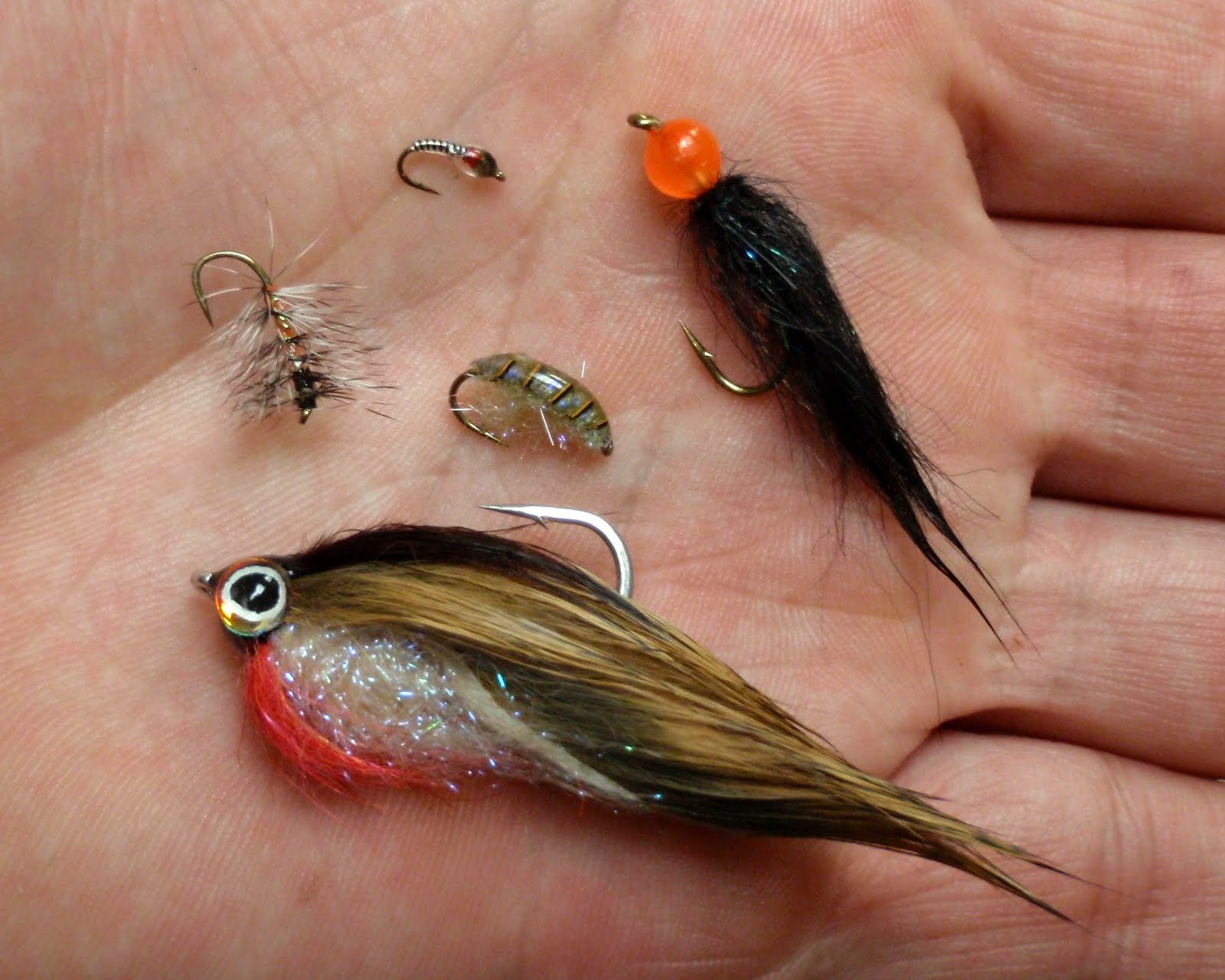
And then, Banjo played his note in the wrong measure, entering the kitchen when he did. The sound of a scape, goated the tease on. "Ever tied a fly with dog hair?" That there, is a crazy idea stimulated by a crazy-good-smelling roast.

Run, my boy...run! But Banjo played on to the composed tune of tying, as my mother and I finger picked his coat over. Repeatedly.

The man grew serious, deep in design; yet he managed to sneak smiles -- threading, tying, dubbing...creatively tying with a coat. As a true artist, a master of his chosen instrument: the vise.


Inside the light grew brighter, as nature's dimmer switch softly set the evening's mood -- like hands did the table. The torment of noses and dog finally whipped to a finish, a very delicious finish. Yet, crazy things aren't ever really completely finished now are they? Nope.....there's always another roast...

The food was divine, the company and conversation comfortable, the laughs plenty, the dog happy with his fat-trimming coat donation compensation, and The Fly? Incredible.


Erin Block
Coal Creek, Colorado

Friday, February 25, 2011

Rods Lost to Ladies

Written and contributed by Shawn Bratt

A guide friend and I were catching up on each others’ lives, to include fishing, beer and women. While discussing the finer points of each I was reminded of a favorite graphite rod that is now sitting in an ex-girlfriends closet and likely has not seen the light of day since I last put it in its’ tube. During the conversation I came to the realization that that is not the only fly rod abandoned with an old girlfriend. At least two more of my cust
om built rods are now languishing away in a closet somewhere. The conversation evolved to discussing the actual locations of these lost fly rods. Did other guys come along and take up the sport using one of them? Did any rods get pawned out of spite for my love of fly-fishing? Could a rod have been burned like I burned one of their clothes after I caught her cheating? Did a once fine split cane turn into tomato stakes for another’s garden? It’s hard to say what the scorned fury of a woman could do to an innocent fly rod.

For weeks after this original fly shop conversation I searched out other stories of romantically lost rods. I recalled how a close female friend (who casts better than most men) still owned a “lost rod”. Over beers she detailed the tale of how she came to own this lovely Scott 4wt. How the original owner had passed it over as a peace offering in the break-up. Since I am a guy who understands o
ther guys, I was suspicious. I sure as hell would not have handed over a rod as a piece offering. So, did she really just steal the rod? I likely will not know for certain until I have beers with the original owner.

Yet another angler reminded me of a particular evening back in college. A relationship had ended over a rod. The two were fishing together and at the end of the day—when putting away gear—she closed a car door on the butt section of his old graphite 3wt. He lost his mind. Things were said and the relationship ended promptly. Later that night he and I had drank to the memory of that sweet little 3wt.

Other fishing friends seem to demonstrate better self control with the ladies. These guys are puzzled that I would actually lone a good rod to a girlfriend for the day, let alone entrust her with one as a gift. I understand their skepticism, but do not enjoy spending as many
nights alone as they apparently do. I suppose many of us male fly fishermen, above anything else, just hope to introduce our wife or girlfriend to our own joy of fishing. We often speak fondly of times and relationships when things are new and blossoming and the prospect of a lifetime fishing partner is still there. Those were my own feelings as I was building that first lost rod—now most likely hidden in her closet or in a thousand little pieces under a sea of landfill.

In the end, I am left with a decision. Do I contact these women from my past? Do I find out where my fly rods are now? No way. I guess I am left with only hope. I hope they all did the good thing and passed the rod along to some eight-year-old stranger floundering on a local trout stream. In my fantasy, she would hand off the rod to the
startled kid, telling him that this object will certainly help his casting, but may be the key to ruining relationships for the rest of his life…


Shawn Bratt--
Boulder, Colorado
Green Drake Bamboo

Sunday, February 20, 2011

Boulder Canyon is Waking Up!

Spring is slow coming in the high country...but, with these beautiful sunny days the creeks are beginning to wake up early this year! If you decide to drive up your nearest canyon creek this weekend, take warm clothes and some small, weighted nymphs. The trout on Boulder Creek seem to be keyed in on midges and small mayflies... Find some open pocket water and run a two-fly nymph rig though it. A #20 black bead-head Zebra midge pupa with a #22 black or purple JuJu Baetis behind it will do the trick. Go during the middle of the day for best chances at feeding fish.

Wednesday, February 16, 2011

The Conception of the Geezus Lizard

The creation of the Geezus Lizard hinged entirely on the conception of the ferruled dubbing loop tail. I have tried for years to build a worm-like fly, or fly appendage, to mimic the rubber worms conventional bass anglers have in their arsenal. The long, narrow look of a worm undulating and jerking near the bottom of a pond or lake is well known for triggering big bass strikes…conventional bass fishermen have know this for decades, one of the reasons long, soft plastics are one of the most frequently used lures. I tried chenille, rabbit strips and a whole assortment of other tying materials…but the end result always looked like a bag of chopped assholes leaked onto my tying desk.
Once I grasped the concept of ferruling a long dubbing loop, it all fell into place. I used durable thread and dubbing wax and some real nice, long fibered dubbing that I could rake out. Then I sexed it up a bit by using two separate colors on either end of the dubbing loop, giving the worm a segmented look. The yellow tip on the tail was a nod to all the old “Mister Twister” tails on the jigs and soft baits I fished to smallmouth bass as a kid in Ohio .
The rest of the Geezus Lizard is modeled after bass flies I have tied and fished all my life. Simple, “pig-n-jig” type stuff using crosscut rabbit strips and rubber legs. The only slight modifications were the true jig style hook and the wire ribbed scud back on the underneath of the fly. This does two things, it makes the fly look a lot cooler…and, on the practical side, it allows the fly to zip right back down to the mud after it has been jerked by the angler. This gives the Geezus Lizard a very unique action it the water, very closely matching the way a spooked crayfish darts out, then immediately tucks back to the bottom. This action has the same effect on bass as a two inch, wounded bluegill listing to one side and darting about erratically! The bass just have to pounce!
I have fished the Geezus Lizard primarily for largemouth bass, but it has been a devastating fly for smallmouth bass, large trout, northern pike and some friends have even used it for reds off the coast of Texas ! It can be fished deep and slow, or fast and shallow…in rivers or stillwater!

Monday, February 14, 2011

Singles Awareness Day

Happy “Singles Awareness Day”! This is a jovial holiday that I have celebrated for many, many years. It is a day when I would traditionally get together with all my other (very single) fishing buddies and toast our freedoms and make off-hand slanders about the opposite sex. So, here’s to all you lone wolves…trout bums…and carp heads! Cheers! And, for all you out there who do have someone amazing in your life who loves you…well, happy Valentines Day to you. Tell that person (who obviously has questionable taste) that you love them, too…(trust me, it is going to get you off the hook and allow for some fishing time later this Spring with our single friends!)

*this year I’ll be celebrating the latter…

Monday, February 7, 2011

Fly Shop Dirt Bags

Attention all fly shops! And I do mean ALL fly shops! There is an active crime spree...targeting small fly shops specifically. There are four people in this ring, two men and two women. The men engage any shop employee, while the women break down as many as 4 high-end fly rods, hide them under a long coat and leave the store. They are all in their late 20's to early 30's, dark/olive complected and speak English with a foreign accent. They have hit many fly shops already in the past week. They are traveling in a very new maroon Volkswagen Jetta (van?) with Illinois plates (K714248). They hail from Rockford, Illinois. The names of the two women are Zofia Zdanowska and Anna Aduba. The photo was taken at a fly shop in Longmont, Colorado two days ago.... PLEASE FORWARD THIS TO EVERY FLY SHOP AND FISHERMAN YOU KNOW!
BREAKING NEWS! (Monday 5:41pm) Longmont PD just reported a VXP fly rod, a bamboo fly rod and a Sharkskin line found in a duffel bag in Longmont!

Tuesday, February 1, 2011

Streamer Hydrodynamics (for geeks only)

As you have probably gathered, we at the shop are not dry-fly purists...nor are we exclusive to trout. We spend a exorbitant amount of time fishing and developing new (and occasionally better) flies for saltwater and warmwater. Most of these flies are what can be lumped into the streamer fly category. "Streamer" is a very general term encompassing a wide variety of flies tied to imitate shad, young trout and sculpin to crayfish and leeches.
We have an almost daily conversation here at the fly shop about new streamer designs and ideas (sometime on the bazaar side...if someone left the lid off the jar of Softex!). Part of our morning routine, apart from flipping the lights on and the OPEN sign by the front door and getting the coffee going...is dumping the fruits of our previous nights tying labors onto the conference table to be perused through and criticized by our co-workers. This very honest feed back (sometimes brutally honest) and constructive exchange of theories and ideas is maybe the best perk of working and being fully submersed into the flyfishing industry.
The biggest questions of a new streamer are always, "How does it look in the water?" and "Does it ride right?".
The most valuable tool a streamer guy can have is a test tank! You never want to waist time on more than one prototype if the first fly acts weird or doesn't keel correctly. At the shop we keep a small aquarium full of water for this purpose. At home I use the kitchen sink, or the bath tub. I can only justify filling up the tub if I have a bunch of different prototypes that have already passed the shop tank or sink tests...and I have the time to jump in for a soak when I'm done! (Another damn good reason to crimp your barbs!)
The most mountainous obstacles to overcome present themselves to the streamer tyer when they are attempting to "flip the hook" or make the fly ride hook up. This enables the fly to be fairly snag resistant and often the other materials will cover the hook, making the fly appear more lifelike. The best ways to achieve this has always been some sort of counterbalance, usually in the form of a dumbbell (although, Rob Kolanda has devised a technique using tungsten nymph body weights to do the same thing). The object is to put more weight on the top of the hook shank than the weight of the entire hook bend, spear and barb. This can be relatively easy to do on light weight hooks such as the Tiemco 8089 and the Gamakatsu SC15, but very difficult on super heavy hooks such as the Tiemco 800s and the Dai-Riki 810.
Two tricks I have learned for dealing with severe cases of Sideways Fly are the "lift kit" and the "eye tweak". The lift kit is a technique using two strips of lead wire to be tied between the eye and the hook shank to push more of a dumb bell's weight away from the center of gravity. This is sometimes necessary when you are tying with a preformed Real-Eye from Spirit River, because they have very skinny arbours, unlike cast lead dumbbells that have fat arbours. This skinny arbour actually allows some of the weight of the eyes themselves to be on the wrong side of the hook shank.
The eye tweak is nothing more than taking a pair of pliers and turning a normally straight eye hook into a down turned eye. This ensures the line will always be coming down to the fly at a 45 degree angle, helping the fly behave correctly. (However, I do not recommend doing this to a Dai-Riki hook. They are too brittle.)
One final thought for those of you getting creative on the vise...AVOID chenille, estaz and any other pre-made body wrap material! These things are unarguably trite. You want your new creations to have a sexy, lifelike and original appearance. Learn to use a dubbing loop to build your own streamer bodies.


If you found this article interesting, check out the comments below...there is some excellent stuff contributed by good friend Evan Jones (author of Fly Fishing in Patagonia).

Friday, January 28, 2011

Surface Film (Potential Date Night?)

Free beer! Live music! And it is being held at a bonafide art gallery…so, you know, possible double-word-score with your significant-other! On Thursday, February 3rd at 6:30 pm at the Anthology of Fine Arts (635 Santa Fe Drive, Denver) there will be an open-to-public display showcasing the works of 20 of the best fly fishing photographers in the business. You can go have a free beer, stimulate your photographic creativity…or just get yourself all worked up for this fishing season. Plus it is the perfect opportunity to get your non-fishing S.O. interested in the sport. Or at last a chance for you the show them how bad ass you look while you’re out on the water. See? That could be me in that photo up there… Nothing like a breath-taking painting or photograph to lend credibility to you and your sport! Perceived total awesomeness is the best cologne, after all! So, pull out your clean jeans and nicest fishing shirt, call up the gal (…or dude?) who hates you the least and I’ll see ya down there!

RSVP Right Now!

Monday, January 24, 2011

Zimmerman Tying at Anglers All (Denver)

Alrighty then...If I missed you all at my new shop a couple Saturdays ago, then hope to see the Greater Denver fly tyers down in Littleton at the Anglers All fly shop this coming Saturday! I will be there from 10am 'till Noon on the 29th of January. It would be great to see some faces I know...makes my time go easier. And, yes...feel free to heckle to your hearts content. Also hope to meet some new tyers. Anglers All Home Page Tying Demo!

Friday, January 21, 2011

Tom Ziegler to Tie at Rocky Mountain Anglers!

Tom, a transplant to the Colorado Front Range, cut his fly fishing teeth on the crystal clear spring-fed streams of the Missouri Ozarks fishing for both wild trout and, in the warmer streams, the wild and native smallmouth bass. His love of warmwater fishing was mated with tying bass bugs after watching a deer hair spinning demonstration at a local fly fishing club as a teenager. The method he witnessed, and eventually learned, was the Lacy Gee method (aka the Wapsi method) of spinning hair. In combination with demonstrating this method, Tom will discuss its history and the use of the final product on local ponds and streams.

Tom has enjoyed fly fishing since his Dad handed him a fly rod at age 10. He is a Federation of Fly Fishers (FFF) Certified Casting Instructor, has won the casting competitions at both the Southern and International FFF Conclaves, and has managed a fly shop (Clearwater Fly Shop in Columbia, MO). He has also demonstrated fly tying at numerous national and regional shows and published a fly tying article nationally in Warmwater Fly Fishing magazine.

Tom will be at Rocky Mountain Anglers in Boulder, CO tomorrow from 11 'till 1pm...there will be free lunch and maybe a stripper pole. We will try to get some of the older gentlemen up in the pole...dolla' dolla' bill, ya'll!

Sunday, January 16, 2011

Learn to tie the Clown Shoe Caddis

Hook: TMC 2487 (#12, #14 and #16)
Abdomen: Medium Lt. Olive D-Rib
Thread: 6/0 Olive and 6/0 Black
Wing: Dun dyed elk hair
Hackle: Dun saddle hackle
Post: Flouresant Cerise McFlyfoam
Thorax: Black Superfine Dubbing

Step 1: Using 6/0 Olive thread, tie in the olive D-Rib at the rear of the hook and wrap forward to the mid-way point. Tie off and trim.
Step 2: Switch to 6/0 Black thread. Stack and tie in liberal clump of dun elk hair. Trim butt ends of hair.
Step 3: Tie in post of Fl. Cerese McFlyfoam.
Step 4: Tie in saddle hackle.
Step 5: Create dubbing rope using black superfine dubbing. Create black thorax on either side of post.
Step 6: Wrap hackle forward, over the black dubbing thorax. Tie off hackle at eye of hook. Whip finish and trim.
Step 7: Trim all hackle from bottom of thorax.

Watch the fly tying video
Click Here To Watch

Thursday, January 13, 2011

Fly Tying Demo

I am excited to announce the kick-off of my fly-tying demo tour! I love doing these demonstrations for a few reasons…paramount being the chance to spend some time in other fly shops in other towns. I get the chance to catch up with old friends whom I may not have seen in awhile. And meet knew fly tiers and somehow negatively influence them! To start off my multi-city romp I get to tie at my new home shop (Rocky Mountain Anglers) in Boulder this coming Saturday. For lunch we will have several big crocks full of Buffalo Chili…as well as all the awesome accoutrements that go along with a meal like that! I will start tying about 11:00 and go ‘till about 1:00. I will be at the shop all day (not just for the good food, but I will actually be on the clock) so feel free to bring your vises and stay later…we can go over some of the patterns I tie on a more one-on-one level, or any other tying help anybody may need. Would love to help work out some early-winter tying kinks. That is what a home-town fly shop is for, ya know!

Of course I will be doing some of my warm-water bass and carp flies…those are sorta my staples. One new bass fly I will be doing is the Booby Frog. This is a fast and easy to tie top-water from pattern that rides hook-up and totally snag and muck free. I use it on all the little bass gravel pits here on the Colorado Front Range during the hot summer months. The little bass ponds have a tendency to moss over just as the bass fishing is hitting its prime. This frog is an absolute killer! I will also be doing some trout flies. To keep the mob at bay… I will tie the Banksia Bug, Clown Shoe Caddis and couple others such as the UV Asher and the Iceman Midge Pupa. I will do my best to be entertaining…informative…helpful…with minimal profanity. See ya there!

Friday, January 7, 2011

How to tie the Banksia Bug

Banksia Bug
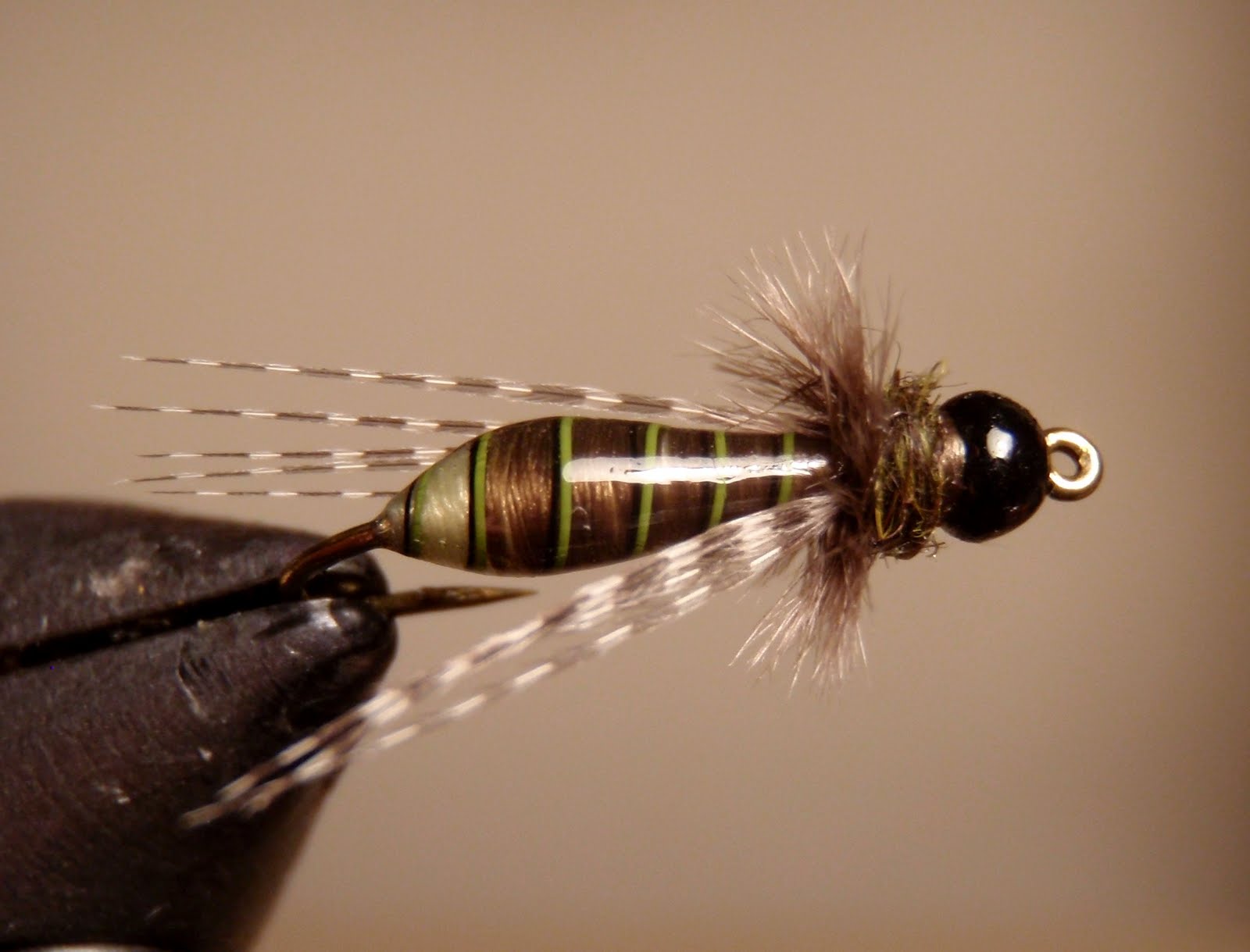
I began tying this fly to imitate the masses of free-living caddis larva in all my home waters here in Colorado and elsewhere in trout streams all over the West. I have rarely found good commercially available flies that can fill this niche. And it’s a very productive fly…probably because this particular caddis larva is a notoriously poor swimmer, often getting swept away in the current, making it an easily recognizable food organism and makes up a large portion of a trout’s diet.
I have found this pattern to work well in rivers with an abundance of small to medium-size stonefly nymphs…leading me to believe my fly is suggestive enough for trout to mistake it for any number of long-bodied aquatic insects. With this in mind, I am now using this fly in lakes…with equal success! I was hoping it could double as a case maker caddis larva, but have found it works exceptionally well in lakes with a lot of active damselflies.

Banksia Bug Tying Instructions
Step 1: Put appropriate sized black tungsten bead on TMC 200R hook (size 7/64 bead on #14 hook). To tie the Basalt version use a TMC 2499SP-BL hook.
Step 2: Using Lt. Cahill 6/0 Uni-Thread tie in both X-Small black UTC Ultra Wire and Small olive UTC Ultra Wire. Apply small amount of head cement to the wires to “marry” them together.
Step 3: Build a fat butt of the abdomen with the Lt. Cahill thread, then tie off and trim.
Step 4: Switch to olive Lagartun or UTC thread and continue building up the tapered abdomen, leaving a small amount of the light yellow butt exposed.
Step 5: Wrap the duel wires forward and tie off behind the black bead and trim both thread and wire.
Step 6: Coat entire abdomen with a liberal amount of Loon UV Knot Sense and set using UV light. This will immediately set up hard, but may have a slightly matt finish, so coat with thin layer of Hard-as-Hull head cement.
Step 7: Tie on legs using 3 or 4 fibers of Gadwall flank feather on either side.
Step 8: Tie in some exceptionally bushy, dark grey ostrich herl and wrap forward.
Step 9: Create small dubbing rope using Dave Whitlock SLF Hellgrammite.
Step 10: Wrap dubbing rope up to the black bead and whip finish. Apply small amount of head cement over knot.
Watch the tying video:
http://www.youtube.com/watch?v=ZG8He3mpa7k

Banksia Bug Tying Instructions

Banksia Bug

I began tying this fly to imitate the masses of free-living caddis larva in all my home waters here in Colorado and elsewhere in trout streams all over the West. I have rarely found good commercially available flies that can fill this niche. And it’s a very productive fly…probably because this particular caddis larva is a notoriously poor swimmer, often getting swept away in the current, making it an easily recognizable food organism and makes up a large portion of a trout’s diet.

I have found this pattern to work well in rivers with an abundance of small to medium-size stonefly nymphs…leading me to believe my fly is suggestive enough for trout to mistake it for any number of long-bodied aquatic insects. With this in mind, I am now using this fly in lakes…with equal success! I was hoping it could double as a case maker caddis larva, but have found it works exceptionally well in lakes with a lot of active damselflies.


Step 1: Put appropriate sized black tungsten bead on TMC 200R hook (size 7/64 bead on #14 hook). To tie the Basalt version use a TMC 2499SP-BL hook.

Step 2: Using Lt. Cahill 6/0 Uni-Thread tie in both X-Small black UTC Ultra Wire and Small olive UTC Ultra Wire. Apply small amount of head cement to the wires to “marry” them together.

Step 3: Build a fat butt of the abdomen with the Lt. Cahill thread, then tie off and trim.

Step 4: Switch to olive Lagartun or UTC thread and continue building up the tapered abdomen, leaving a small amount of the light yellow butt exposed.

Step 5: Wrap the duel wires forward and tie off behind the black bead and trim both thread and wire.

Step 6: Coat entire abdomen with a liberal amount of Loon UV Knot Sense and set using UV light. This will immediately set up hard, but may have a slightly matt finish, so coat with thin layer of Hard-as-Hull head cement.

Step 7: Tie on legs using 3 or 4 fibers of Gadwall flank feather on either side.

Step 8: Tie in some exceptionally bushy, dark grey ostrich herl and wrap forward.

Step 9: Create small dubbing rope using Dave Whitlock SLF Hellgrammite.

Step 10: Wrap dubbing rope up to the black bead and whip finish. Apply small amount of head cement over knot.


Watch the Tying Video!


(Note…the Banksia is a knarly tree native to eastern Australia, named after Sir Joseph Banks (botanist cir. 1800’s). A very popular children’s book “Snuggle Pot & Cuddle Pie” an Australian version of “The Wizard of Oz” features a creepy, evil character called a Banksia Man…that looks like the cone from the Banksia tree.)


Thursday, January 6, 2011

Wanna go to Belize with us?

Rocky Mountain Anglers is excited to host a week of fishing at Turneffe Flats Lodge in Belize. Located on The Turneffe Atoll, 90 minutes from the mainland, the lodge is surrounded by 250 square miles of flats and reefs rich with marine life adding to your overall experience. The fishing here is world class with the possibility of a grand slam on any given day of the year. The permit fishing has been written to be the best anywhere, and where else can a new saltwater angler catch so many bonefish that their arms start to ache. A terrible problem to have!!
Turneffe lodge has experienced, English speaking guides, and luxurious accommodations to make your visit one to remember. Rooms are double occupancy with air conditioning, with beautiful views of the ocean just a few steps away. There are beautiful flats teeming with bonefish right out your door. The friendly staff prepares excellent meals using local produce, freshly baked breads, and of course seafood. Meals are served family style in the main lodge, where the bar, gift shop, and fly shop are also located. Special dietary needs or restrictions can be accommodated and the excellent meals reflect Belizian

and international influences. Dinner is a very social event following drinks and hors d’oeuvres, and includes a soup or salad, a delicious entrée of chicken, pork, beef, seafood, or a combination. Desserts are to die for as are the fresh breads and pasteries for breakfast.
Three meals are served daily, and fisherman have the option of returning mid day for lunch at the lodge, or taking it on the boat.The views and vistas as well as the diversity of wildlife have made this a truly special salt water destination. The lodge also offers scuba diving and reef or eco-tours as well as the world class flats fishing. This is a great spot to come with a significant other to relax and be pampered in the warm waters and white sands of the Caribbean.
Turneffe Flats Lodge is the best saltwater destination for anglers of all experience. The sheer numbers of fish allow repeated shots for anglers first stepping in the salt. And for anglers wanting more of a challenge there are larger fish, as well as tarpon and snook in the area. While present in fewer numbers the tarpon are around 100 pounds with fish closer to 200 pounds caught each year. The best permit fishing anywhere, schools of bonefish out your front door, and the chance of a tarpon or snook as well. This place rocks!!! Anglers are often limited to only a single species on their excursions, but not here! The diversity of gamefish means you may catch all bonefish one day, permit the next, and a tarpon on the third.

Many friends have traveled to Belize, coming back with photos that will make you envious. I never like to say anything is easy, but Turneffe Lodge is as close to a sure thing as you will find. The fishing here is world class and the lodge has made a name for itself as one of the best in the business. When the snow is flying in Colorado think how relaxed you could be south of the border. Come join us in paradise for a saltwater experience to remember. (Call the shop, 303-447-2400 and talk to Randy to get more info!)
Trip dates: March 12-19, 2011.
Price $3883.95(does not include airfare, tips, alcohol or purchases from the gift or fly shop)

Wednesday, January 5, 2011

Tying Flies with Loon Outdoors UV Light

I made this 10 min YouTube video demonstrating five different ways to utilize the Loon Outdoors UV Knot Sense and Fly Paints. Tie an Egg Sucking Leech, Olive UV Back Scud, Iceman Midge pupa, Bellyache Minnow Streamer and the UV Asher dry fly. You are bound to learn something new and cool!

Watch The Video

See More On You Tube
Egg Sucking Leech: Hook—TMC 3761, Tail—black arctic fox, Body—Simi Seal dubbing, Egg—Orange UV paint,
Olive UV Back Scud: Hook—TMC 2487, Wire—UTC small black and ginger, Dub—Lt. olive UV Ice Dub.
Iceman Midge: Hook—TMC 2488, Thread—Uni-Thread red and olive dun, UTC Wire x-small silver (2 strands) and one strand x-small black.
Bellyache Minnow: See additional fly tying video— BellyAcheVideoUV Asher (Orange): Hook—TMC 100, Grizzly hackle, 6/0 fire orange Uni-thread, and black, Lateral Scale (Orange Dyed Pearl).

Monday, January 3, 2011

The Male Ego…

A young woman in her mid-twenties told me I was the most incredible man she had ever met. And…for a few hours I actually believed. I stood in a strange shower the next morning squeezing oddly scented shampoo onto my head, basking in hot water and my own awesomeness…deliberating whether I should go ahead and wash my hair along with the rest of myself, or forgo the hair and not risk freezing my ass off on the winter morning drive down the icy canyon and into work at the fly shop. I decided against it…left my hair dry. Rode down to Boulder in comfort, with a dry head and hot travel mug of coffee handed me by the previously mentioned young woman as I headed out the door. At the shop I was confronted by close friends curious of my mysterious vanishing the previous evening as well as a newly arrived fishing magazine with a big center-piece article about me. An innovative fly tier with deadly and artistic prowess the article claimed. I dodged the questions about my ware bouts the night before and nodded nonchalantly at the magazine, as though it all were fairly commonplace in my life. I am kind of a big deal, I thought to myself. All these people are right. Handsome. Incredible. Talented. And oozing prowess. Then I scratched my head and realized my ball cap had adhered to my scalp. Not due to an ever swelling ego…but because the un-rinsed shampoo from earlier in the morning had hardened and fastened my hat firmly to the top of my head. The guys all pointed and laughed. Aaaaah…the un-graceful crash back to reality!

Saturday, January 1, 2011

Winter Carp Fishing

Happy new year all you fly fishing junkies! I know it’s cold. I know…all the leaves are brown. And the sky is grey. And you are probably thinking to yourselves… “I’d be safe and warm…if I was in L.A.” But you ain’t! So suck it up and go fishing. You can even get out and get your first carp of the year! The reservoirs are still under a heavy layer of ice, but some of the creeks are open. The fish will not be super aggressive, but they may have their heads down looking for easy food. Put on some warm camo and look for big carp circulating in the deeper pools and tailouts…or, just sit back and watch this sweet video instead!

Friday, December 31, 2010

Craziest Fly Shop Questions of 2010!

#1 "What fly should I put the floatant on? The dry fly or the leech?"

#2 "Why is it so important that waders be waterproof?"
#3 "My line is winding onto my reel very loosely...when I tighten my drag it seems to help. Do you have any other suggestions?"
#4 "It looks like all you have are looped leaders. I don't like looped leaders. Do you have any without loops?"
#5 "Do you have pants that go over pants...so my pants won't get wet?" We have waders. "No, I already have some of those."
#6 "I applied a small amount of super glue to the end of my fly line to seal a crack...has this changed the weight of my fly line?"


See Craziest Of 2009!

Sunday, December 19, 2010

Colorado Greenback Cutthroat Trout (A Fisherman's Guide)

When this book came out many of my friends (who spend a lot of time fishing the high lakes) were pissed off. They were upset because many of their favorite cutthroat lakes and the hiking routes were mentioned. This told me one thing: I needed a copy! And, now...that I do own a copy, I am a bit nervous about it. My favorite lakes are mentioned, too. But, here is the final analysis...it is a great book. And every fly fisherman who lives in Colorado and hasn't had hip replacement surgery yet... should own this book. It is as close to a "must have" book as you are gonna find. Perfect bound book, only $19.95 new...full of information and notes. All the good, pertinent stuff for those of us who have fallen in love with the Colorado high country. There is something about being above treeline...makes my blood thicken and my heart race! And, to get back to my friends...and their hurt feelings. This book does not "hot spot" anything. It outlines every spot here in the state of Colorado were we can find our only native trout. A magnificently beautiful fish. Stunning. The book does not give any one particular lake more attention than any other. As I sit here indoors in December...staring at the front cover, I already have two or three overnight trips planned for next summer. Damn! Can't wait!


Colorado Greenback Cutthroat Trout (A Fisherman's Guide). Jim Rubingh & Richard Fritz. Frank Amato Publications, Inc. Buy A Copy Amazon.Com Or, better yet, stop into your local fly shop and get yerself a copy!