
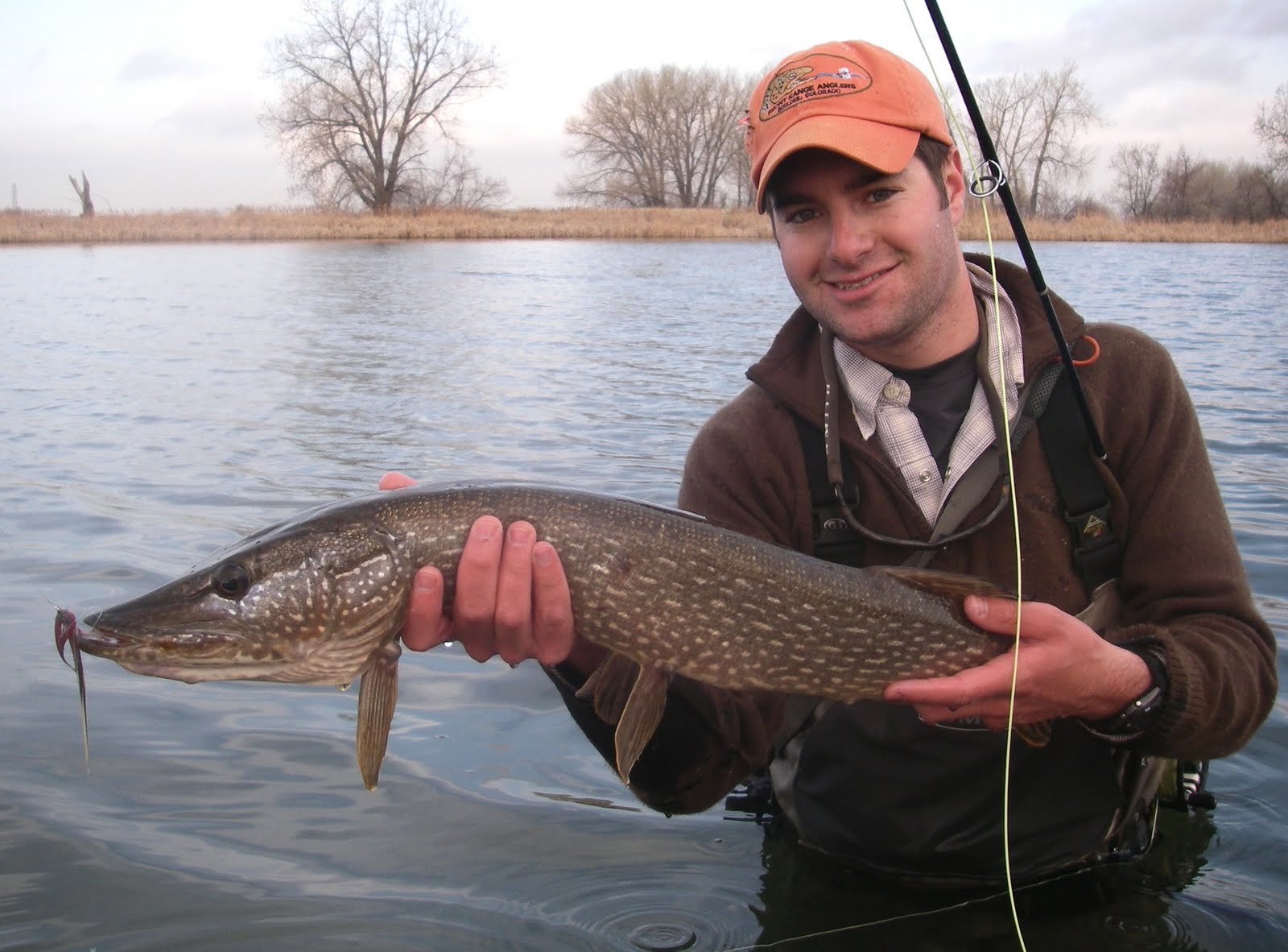
Northern Pike are an exciting quarry. Many spin fishermen and bait casters are aware of how fun pike can be, but fly fishers are mostly oblivious. Less than 15% of fly fishermen in Colorado have ever cast to pike or musky. I believe the main reason for this apparent lack of interest is intimidation. This intimidation is not necessarily a fear of the fish itself (although they are a vicious, potentially dangerous animal) but a fear of the heavy gear that comes along with fishing for them. Most of us are trout fishermen at heart and have long owned the gear that goes along with it. We are comfortable with a 4 or 5 weight rod, 9 foot 5x tapered leader and hordes of size 16 and 18 trout flies. But a pike fisherman needs to possess a larger rod, usually an 8 weight, and a strong casting arm. You will be casting heavy flies—that won’t fit in your trout box—and you will have to cast them as far as you can…over and over again. Once a fisherman gets over the initial gear and casting challenges, catching pike is relatively easy. These fish are hyper-aggressive predators, sometimes preying on other fish with reckless abandon. It is often easy to take advantage of this type of behavior. However, becoming a consistent and productive pike fisherman does take years of experience and close observation.
 Choose Your Rod
The most common fly rod used for pike here in Colorado is a fairly stiff 9 foot eight weight, but sometimes a longer rod can be useful. Often a 9½ or 10 foot eight weight is used. The advantages of a long rod are many; you can cast larger flies longer distance, throw your back cast over tall cattails (even when you’re in waist deep water) and you can bring the fly past you at the end of your retrieve farther away making the fish less likely to spook. If you are planning a fishing trip to Alaska or Canada you would be well advised to take along a nine or even ten weight rod. There are areas up there where pike well over 50 inches long are not uncommon. An eight weight rod can handle these big fish, but casting the large flies all day is made much more enjoyable on a heavier rod.
Fly Line & Leader

Usually I recommend a weight forward floating fly line of a line weight corresponding to the rod you are casting. There are several exaggerated weight forward fly lines out there designed specifically for casting large flies…naturally, these are ideal. There are times when a sink tip fly line can be a good choice. If you are searching for pike in deep water (late season/late afternoon) or if you are casting lighter weight flies. Most leader conversations revolve around the type of bite tippet preferred. The entire leader is anywhere from 8 to 10 foot long and fairly robust. There are three main types of bite tippet commonly used at the end of a pike leader.
1. Wire. The advantage of a wire bite tippet is eliminating all bite offs, but the disadvantages are many. A thick wire adds weight to an already heavy fly and makes casting more challenging. Heavy wire is stiff, too, so the fly looses much of its’ natural and seductive movement—a loop, or jam knot will solve this problem, but add an ugly mess to the front of your fly. If the wire is thin enough to minimize the disadvantages, it will have an annoying tendency to “pig tail” or permanently coil up after the shock of fighting even an average-sized pike. The only time to consider using a heavy wire bite tippet is when you’re traveling to a fishing destination that is known for harboring large, unpressured pike. The fish in these areas aren’t usually as sensitive to clunky gear and you will be using a heavier rod (9 or 10 weight) so the bulky rig won’t be as detrimental to your casting.
2. Hard Mono. There are great advantages to using hard monofilament. Mono is much lighter weight (so casting is not a concern) and coiling isn’t as problematic. The disadvantages are still many, though. Hard mono is fairly stiff, so you will still have the problems of unnatural fly movement. Also, tying knots is cumbersome. But the worst disability is the toughness. Many fly fishers use this type of leader and live with a high loss rate of hooked pike due to bite off.
3. Braid. The braided material usually used is Spiderwire. It is quite limp, so you will get excellent fly movement and it is no heavier than regular monofilament. The two main disadvantages are maintenance and availability. Most multi-venue fishing stores carry the stuff, but here in Colorado they usually only have it up to 20 pound test. The kind you want is the 80 pound Spiderwire. The most reliable source I have found is ordering from Cabela’s. You can get a 300 yard spool for $25.99…and this could last you and two of your buddies a lifetime. The best way to set up a pike leader with braided bite tippet is as follows: start with a 9 foot 0x tapered monofilament leader and clip off the last two feet of tippet. Replace what you removed with 24 to 30 inches of the 80 pound braid. The braid is strong and can easily damage the mono, so use a double uni knot to attach the two and be gentle when tightening. Use an improved clinch, or whichever knot you usually use for attaching the fly. And lastly, always cut off your fly after every landed pike, trim the couple inches of gnarled braid and retie. If you do this religiously you will reduce the number of bite offs to almost nothing.
Pike Flies
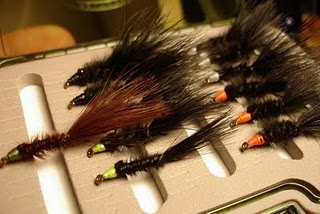
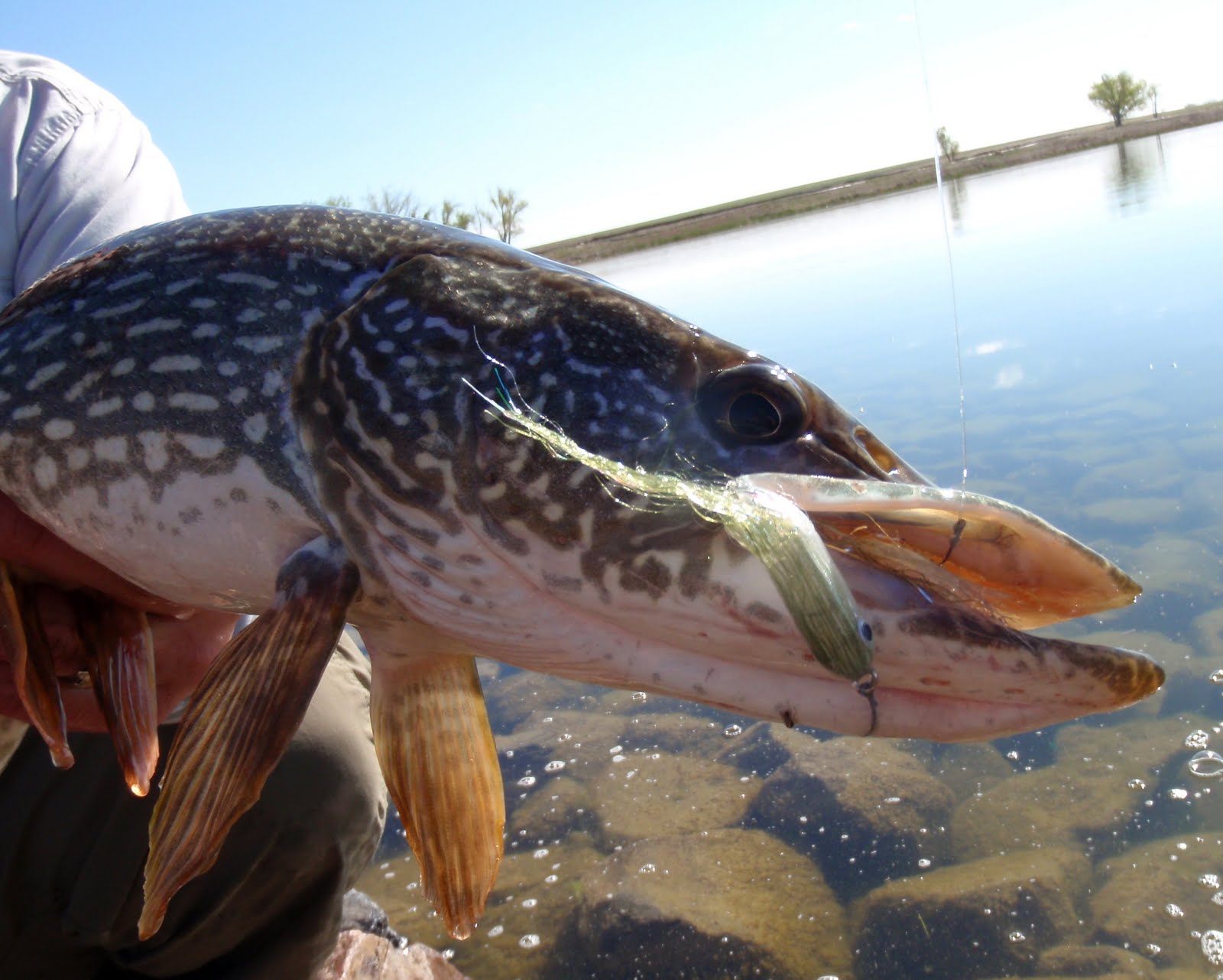
Pike flies are some of the largest and flashiest that you will find in a fly shop. Most are a subsurface baitfish imitation ranging from three to seven inches long with size 2 to 4/0 hooks. Some of the common color combinations are black/white, red/white and red/yellow. Occasionally top water flies are used. You can identify these top water pike flies from their usually large clipped deer hair head and long tail. Hooking a pike on a surface fly is unbelievably cool (the take is always impressive!) but this type of fishing is usually only productive when chasing unpressured fish in a body of water that has a large number of pike. The high

level of competition for food forces them to be more aggressive and opportunistic. If you are trying to get by using a lighter fly rod than is recommended, you have to be very careful with your fly selection. Look for smaller streamer patterns—three inches long and slim in profile—and take note of what materials the fly is tied with. Synthetics retain far less water than natural material once you begin fishing. A big rabbit-strip fly can almost double in weight after the first cast.
Some Tricks
As the water begins warming up in the spring the pike will start moving out into deeper water. They won’t all move out at the same time, they will disperse in waves according to their size. The larger ones are the first to go and by the time the water temperature rises into the high 60’s there will be nothing but the smallest pike left in close to shore.
Pike see color, but don’t see details clearly. This is why the gaudiest and most obnoxious flies will often work as well as some of the more realistic ones. The pike see what looks to be a crippled or wounded young fish (erratic, flashy movement) and the attack instinct kicks in!

Most of pike fishing consists of either blind casting to deeper water or along shore and weed lines, but sometimes you will see a pike in shallow water laying still…always cast to it! The pike could be laying in ambush, waiting for a frog or small bass to bumble out of the weeds, and will pounce on your fly. If the pike doesn’t make a move for your fly—and some won’t—don’t beat yourself up. Many times they are just basking in the sun, trying to increase their body temperature and are not interested in eating.
Use a stripping glove, or finger wraps on the index and middle fingers of your casting hand. Continually bringing in line with quick, jerky strips over those two fingers with the weight of a large pike fly at the other end will burn nasty groves into your skin. They hurt like hell and take forever to heal.
A bit of wind can be good, especially on a sunny day. The chop on the surface will break up the sunlight and stir up baitfish from their hideouts in the cattails and tall grass. An overcast day can mean excellent pike fishing, as well—the low light is ideal for hunting. Although, above all else is weather consistency.
Always watch close for followers…fish each cast past yourself so that you can see if there is anybody tailing your fly. As you are retrieving, try to spot your fly in the water as soon as possible…then focus hard on the void about two feet behind it.
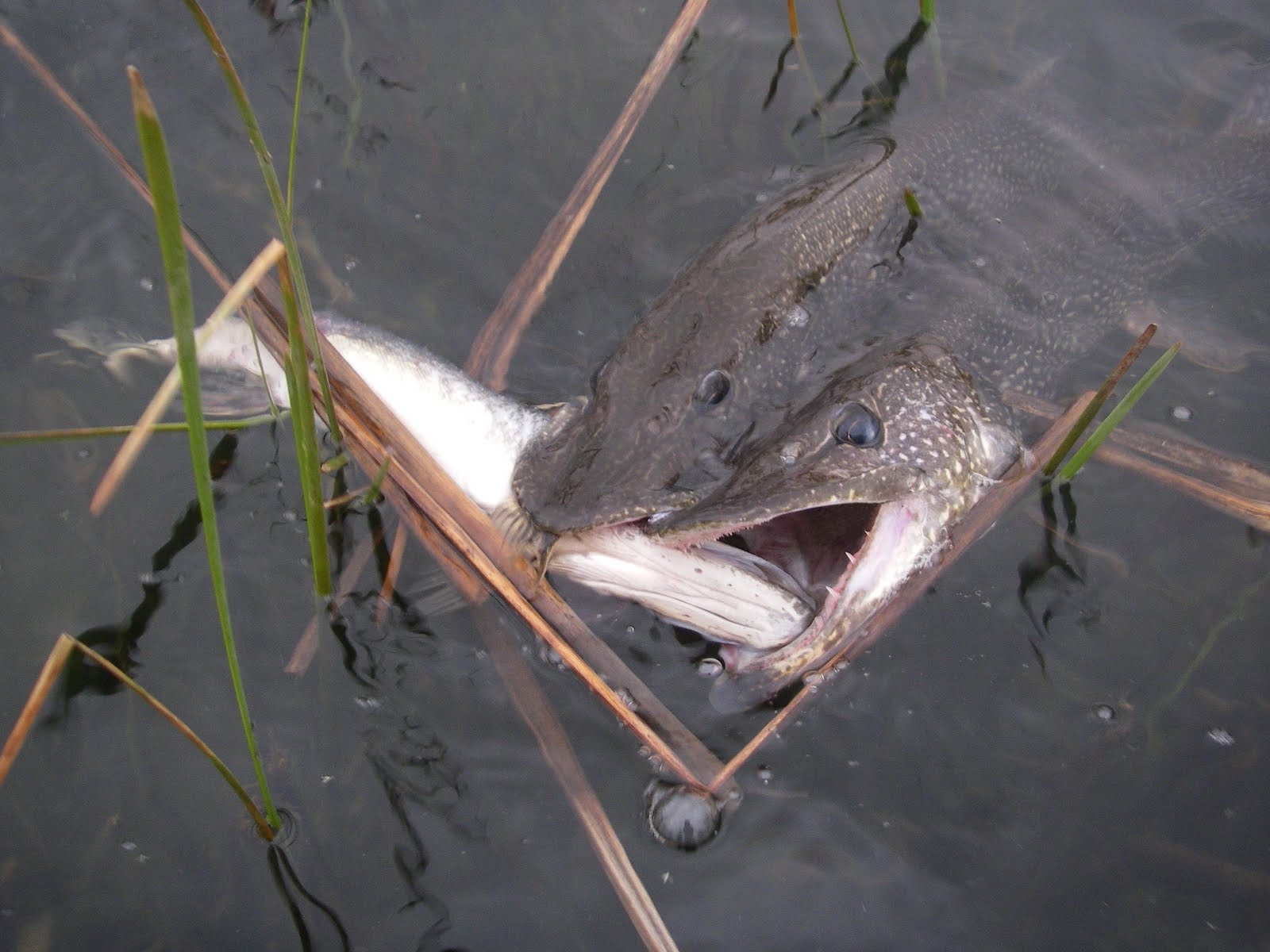
Pike are a strong fish, but will rarely take you the 90 to 100 feet necessary to get you into your backing. With long, snake-like bodies they are built for short bursts of speed—they will often coil into a loose S and then lunge. This perfectly suites their ambush style of hunting. The pike body shape is the main reason for their reputation among anglers as a weaker fighting fish. A fisherman can keep a long-bodied pike off balance during the fight without having to try too hard. Consider the scenario from the perspective of the fish. A tussle with a fisherman is an aquatic version of the bus-pulling venue at a strong man contest. You never see a basketball player allowing himself to be tethered to a bus.
When fighting a pike always be conscious of how your fly line is being wound back onto to the reel. The heavier weight-forward lines used for casting pike flies are generally much thicker than most trout fishermen are used to. Treat the pinky finger of your casting hand as if it were the level-wind mechanism on a bait casting reel.

It is a good idea to bring along some sturdy pliers to help with fly removal once you land a pike. A set of wire jaw spreaders ain’t a bad idea either.
The Spawn
Pike spawn early in the spring when the water is still very cold (low 40’s). The larger females move into shallow water accompanied by several smaller males. The female will spew her eggs over muck and weed-lined bottoms, usually in shallow bays and creek inlets. This goes on for less than a week, although all females don’t start and end at the same time. Then the females move back out into deeper water to rebound from the pike version of spring break gone wild. The males will hang back in the shallow water to watch the game on television…always with an eye out for an easy meal.
Terminal Strategies for Landing More Pike
Leader: Loosing fish to “bite-offs” is a part of pike fishing, but it does not have to play as big a part as most fly fishermen let it. Use a bite tippet that limits these bite-offs to a minimum. (See leader section)
Fly: Because northern pike are notoriously over-aggressive predators the flies most commonly used are attractor streamers. These are usually large and extra flashy. A good pike fly fisher will use these types of flies, but also have a decent selection of smaller and/or more realistic baitfish and crayfish patterns. Have these flies available, but also be willing to use them. Knowledge of the most abundant and available food source in the water at hand is very important.
Hook: Hook selection in pike flies is usually overlooked—but it is very important, especially when the fishing is slow. In a typical day of pike fishing in Colorado a handful of fish hooked is a great day. Using flies tied on the best hooks will dramatically improve your hooked to landed ratio. Often you will see commercially available pike flies tied on very thick hooks with over-sized barbs. These are fine if you are chasing the big boys up in Alaska, but are responsible for countless hooked and lost pike here in the lower forty-eight. The hooks do not have nearly the penetrating ability on lighter-weight pike. Also, many of these hook styles are rendered completely worthless for holding fish once the barb is mashed down. Carry a good hook sharpener with your pike gear…more importantly, use it! I tie the majority of my Colorado pike flies on two different hooks—the Tiemco 8089 sizes 2, 4 and 6 and the Gamakatsu B10S sizes 1, 1/0 and 2/0 . One hook style I have learned to avoid is the Dai Riki 810. At a glance this hook looks similar to the more expensive Tiemco 800 series (also a great pike hook) but has two major differences: the “spear” is shorter and not nearly as down turned. If you don’t tie your own flies, don’t hesitate to wander over to the hook wall of your local shop and get to know these hooks. Look for commercial flies tied on hooks that have a wide gape and a long spear.
The Barbless Fly Debate
For trout fishing it is a no-brainer: crimp your barbs! Barbed flies will kill or at least severely mane and disfigure trout. But pike are tough; a barb alone will not do much lasting damage. Having said that, here are three good reasons for de-barbing pike flies: 1—The excessive handling that goes along with releasing a large fish hooked on a barbed fly WILL do harm. 2—Barbed flies are very difficult to remove from deep in the mouth of a pissed-off fish that happens to have far more (and sharper) teeth than you do! You will save doing damage to both your hands and your flies. 3—If you are ever going to have a fly buried deep in the back of your scalp…it is a pike fly. They are usually larger and heavier, thus a lot more difficult for a trout fisherman to cast.
Read More About Pike!






 We were not the first ones to the gravel pull off, Erin and I. A late start, a stop for coffee and one wrong turn up a dirt road. Oh well. The two guys ahead of us looked decent enough—two fellow fly fishers—not a couple of turds who would likely camp out on fish or high hole us. I’ll get back to this. They were already wadered up and about to hit the trail down to the South Boulder Creek tailwater. I was going to give a good luck wave and see ya down there, but before any of those niceties could be exchanged a big pickup truck lurched into the pull-out next to us. As the dust was settling a big man in a tight “I Once Went to Sturgis” T-shirt rolled out of the cab with his scraggly haired son. He strolled over to us somehow coming across as a condescending jackass and a hapless oaf all in the same greeting. “Looks like ya’ll goin’ brookie fishin’!” (To me.) “Hey there, kiddo.” (To Erin.) He slung his beefy arms over the gunnels of my truck bed, his boy lingering sketchily behind him like that crazy pet-like-thing-on-a-chain in Jabb
 The walk down the trail was steep and twisted, but we were down to the bank of South Boulder sooner than I would have liked. It was one of the first really hot days of the year and I was enjoying the walk and the company. Erin and I were having a good chuckle over the encounter in the parking area. I was finding every opportunity to call her “kiddo”. I had my 3wt rod rigged with a two-fly nymph set-up—a #20 midge pupa and a BWO emerger—same rig that was working so well for me on the Big Thompson just the other day. But, the trout on SBC were not interested in either bug this day. It took me swiping at several annoying insects crawling up my jacket


 (Poems by J.Zimmerman)


 ...found in a line of trees, a donut pond, and the feeling I get driving home on cow pasture lined highways. These things I seek. They infected me early, and I am a lifelong carrier. Consciously or sub.....I will leave that to you, reader, to decide. But wherever I go, I recreate bits of home. I find it. It is why I have a clock above my kitchen sink, why I sing old Baptist hymns when no one is around, why I don't hang curtains on my windows, why I kick piles of horse shit to "freshen" the air, and why I love being above treeline...
 ...I crave Midwest horizons. Ironically, now I live in a canyon. But we adventurous ones, we always find home. And, in the most curious of places -- there are always reminders. Even, in a canyon compassed view. And even, in the smell of a farm pond...


